

New Honors
In the US, the early months of the year bring news of artists selected for several high-profile annual artist awards. As in other recent years, 2026’s announcements recognize those opening new registers of disability- and access-oriented aesthetics.
This year’s United States Artist Fellows, for example, include writer, artist, and musician Johanna Hedva and artist Nat Decker. The Creative Capital for Artists awards include poet and playwright Rob Macaisa Colgate and transdisciplinary artists and writers Liza Sylvestre and Christopher Robert Jones.

Although the Disability Futures Fellowship has sunsetted, another disability-focused prize program, the Wynn Newhouse Awards, is celebrating its 20th anniversary with an exhibition called Possible Worlds at the Syracuse Museum of Art through May 9.
When disabled artists get their flowers, it’s a joyous rebuke of the ableist status quo. Individual-level recognition can be signals and invitations. So what do we know about how these prizes factor into disabled artist’s lives and livelihoods? Today, we’re publishing original reporting from Clayton Jarrard on a larger context for this kind of awards season.
Artist Awards and Artists’ Lives
Awards and grants can provide crucial financial resources, exposure, and career development for artists. As disability art continues to brilliantly proliferate, awards season is an occasion to think about the broader political economy of artists’ lives and livelihoods.
The Creative Capital Awards, an unrestricted grant program funding projects up to $50,000, reached a watermark year in 2023, funding 9 projects on disability out of a total of 74 awards. Reviewing the $50,000 United States Artists Fellowships from 2016-2026, we observed 18 fellows working in the name of disability out of the 503 fellowships awarded across the decade. Similarly, the $45,000 Foundation for Contemporary Arts Grants to Artists went to 10 artists working in the name of disability out of around 226 in the same period.
It is important to note that these figures are approximate because there is no exact calculation of “disability artistry.” We used the artists’ description of disability in their work to arrive at these data, which don’t account for many proximate aesthetic spheres. As disabled artists explore disability identity as an impressionistic, porous, and unstable category, it is both difficult and important to consider “disability representation” as a small fraction in these national, discipline-spanning award cohorts. These necessary imprecisions draw us deeper into curiosity about the competitive framework for accessing funds and career-changing exposure.

Choreographer, performer, writer, and teacher Jerron Herman, a 2021 Foundation for Contemporary Arts awardee and 2024 United States Artist fellow, told Crip News, “I stay cautiously optimistic about [the awards] but know that they can be destabilizing in many forms to Individual artists because they’re not sustaining grants. You get this support, fantastic, but after your award year is over the field looks at you like you’ve made it and you’re on your own.”
Artist-organizers Natalia Linares and Caroline Woolard characterize the effects of the arts sector’s “superstar system” in their 2021 report “Solidarity Not Charity: Arts & Culture Grantmaking in the Solidarity Economy.” Pointing to the activism on economía solidaria in Latin America and the alternative forms of creative resource distribution and management, they explain, “The systems that artists want are not only possible, they already exist—and they can be strengthened and cultivated with intention.”
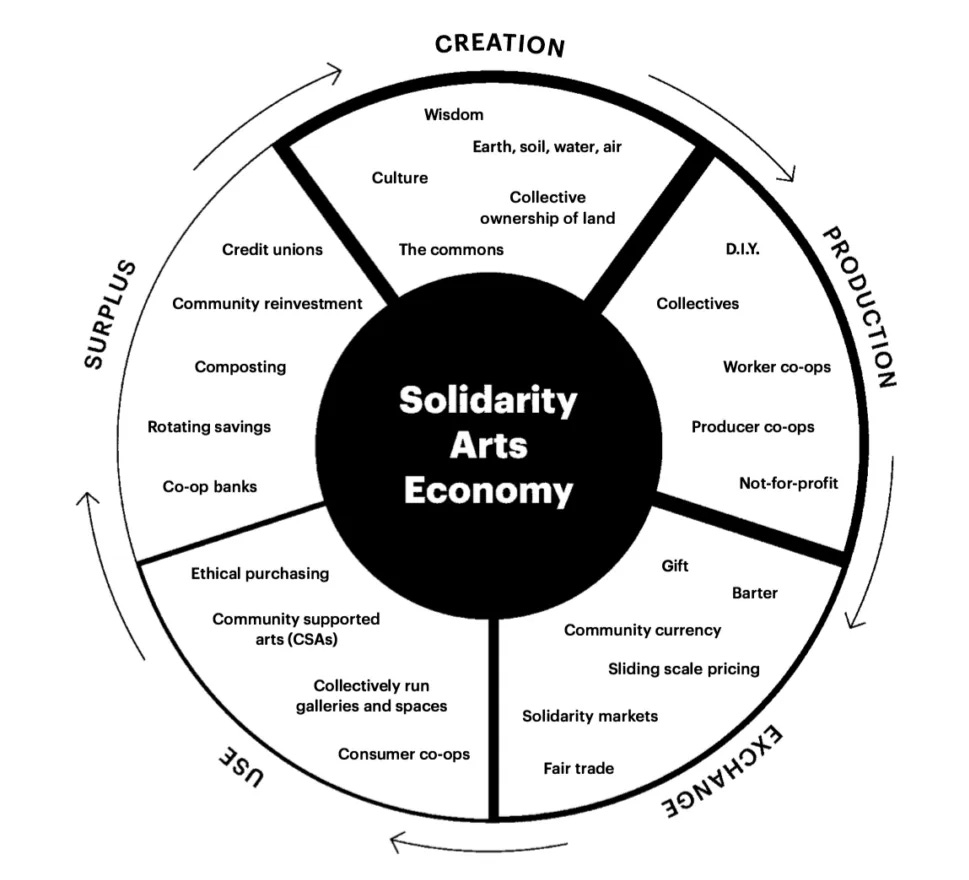
Can awards systems match how disabled artists value solidarity, tying prize money to housing justice, food sovereignty, land repatriation? One still-incipient movement, Guaranteed/Basic Income for Artists, is demonstrating the possibilities of cash for material redistribution while being ensnared by the ceremonies of social humiliation inherent to punitive eligibility requirement for public benefits programs.
Linares, who recently organized an event on “How Artists are Reclaiming the Economy,” draws inspiration from projects like Brooklyn-based comics raising funds for the East New York Community Land Trust, the Make Streaming Pay campaign by United Musicians and Allied Workers, and the Many Hands Workshop for mass movement art in NYC.
“What would it look like if dozens of artists did things like this? Dozens of dozens?” she recently told Crip News. “To continue that sort of mutual aid in the service of solutions that get to the root cause of precarity rather than uphold this false notion of meritocracy!”
Clayton Jarrard is a graduate student at New York University’s XE: Experimental Humanities & Social Engagement program. Clayton works in applied social research and policy implementation and is also a host for New Book Network’s podcast channels in Disability studies and LGBTQ+ studies. He previously reported with Crip News on AI and the Care Crisis.
Thanks for sharing this! I'm glad these kind of opportunities exist for disabled artists, but wish they had more accessible application processes. (Which I wrote about for Fractured Atlas: https://blog.fracturedatlas.org/arts-worker-horror-story-2025)